
If you are launching a skin care or hair care brand without your own factory, one question comes up early: do you need a cosmetic loan licence, or can you sell under your manufacturer’s licence? The answer decides your paperwork, your launch timeline and what is printed on every pack. This guide explains both routes under the Cosmetics Rules, 2020, the forms (COS-5, COS-6, COS-8, COS-9), fees, documents and labels, so you can plan your third party manufacturing launch with your eyes open.
We are a third-party manufacturer, not lawyers. Use this as a working map, and confirm the final position with your State Licensing Authority or a regulatory consultant before you print packaging.
What the law says: manufacturing licence vs cosmetic loan licence
In India, cosmetics made for sale need a licence from the State Licensing Authority (the state drugs control department). Rule 23 of the Cosmetics Rules, 2020 says that anyone who intends to manufacture cosmetics for sale or distribution applies for either a licence or a loan licence:
- Cosmetic manufacturing licence: for a company that owns or runs its own manufacturing site. The application is made in Form COS-5 and the licence is granted in Form COS-8.
- Cosmetic loan licence: for a person who “intends to utilize the manufacturing site of another licensee” (Rule 3). The application is made in Form COS-6 and the licence is granted in Form COS-9.
Both applications go with Form COS-7, a self-certificate that the premises follow Good Manufacturing Practices under the Seventh Schedule. In other words, a loan licence lets a brand owner hold a licence in its own name while the product is made in a licensed plant that it does not own. That is why the term matters so much to founders working with a third-party manufacturer.
Do you need a cosmetic loan licence for third party manufacturing?
Not always. In practice, Indian brands launch through one of two routes.
Route A: manufacture under the manufacturer’s own licence
Your product is manufactured under the third-party manufacturer’s cosmetic manufacturing licence. The label carries the manufacturer’s name, address and licence number (as Rule 34 requires), and your company appears as the brand owner or marketer (the familiar “Marketed by” line). You still own your brand, artwork and, if agreed in writing, the formula, but the licence belongs to the manufacturer.
Route B: take a cosmetic loan licence in your name
You apply to the State Licensing Authority of the state where the plant sits, using the manufacturer’s site. The licence number printed on your pack is then your own loan licence number. You take on more paperwork and more regulatory responsibility, and in return the licence is yours.
Some advisers say a brand owner should always hold a loan licence; many brands in the market launch on Route A. Practice can differ between states, so treat this as a decision to confirm with the licensing authority, not one to guess. The comparison below shows what changes for you.
| Point to compare | Route A: manufacturer’s licence | Route B: cosmetic loan licence |
|---|---|---|
| Licence holder | The manufacturer | You (the brand owner), using the manufacturer’s site |
| Forms | Product is covered on the manufacturer’s licence (COS-5 / COS-8) | You apply in COS-6 with COS-7; licence is issued in COS-9 |
| Government fee paid by you | None for the licence itself | Licence fee as per the Third Schedule (see below) |
| Licence number on pack | Manufacturer’s M.L. number | Your loan licence number |
| Time before first batch | Mainly product endorsement on the manufacturer’s licence | Up to 45 days for a decision under Rule 23(5), plus preparation |
| Technical staff | Manufacturer’s staff | Named technical staff supervise your manufacture (Form COS-9) |
| Moving to another manufacturer | New manufacturer must cover the product | A new loan licence is needed for the new site |
| Best for | First launches, small ranges, testing the market | Brands that want the licence in their own name and more control |
If you are testing a small first range, Route A is usually simpler; if you want your own licence number on the pack and more control over production, Route B is worth the effort.
Cosmetic loan licence fees, timelines and validity
The government fees are set in the Third Schedule of the Cosmetics Rules, 2020. As listed by the Drugs Control Department of Delhi, both a manufacturing licence and a loan licence carry a fee of ₹10,000 for up to ten items of each category, plus ₹500 for each additional item. A fresh application after rejection costs ₹1,000, and a duplicate copy of a licence ₹500. Check your own state’s fee table and payment mode before you file, because portals and challan formats differ.
The rules also set clear timelines:
- Decision within 45 days. Rule 23(5) asks the State Licensing Authority to grant the licence, or tell you what is missing, within forty-five days of the application.
- Inspection within 30 days of grant. Rule 23(7) provides for an inspection of the site within thirty days of the licence being granted, and Rule 31 requires inspection of licensed premises at least once every three years.
- Valid in perpetuity, with a retention fee. Under Rule 30, a licence stays valid as long as the retention fee is paid before five years from the date of issue. Late payment carries a fee of 2% per month for up to 180 days, after which the licence is deemed cancelled.
These are outer limits; incomplete files are what usually cause delays.
Documents checklist for a COS-6 application
The Second Schedule of the Cosmetics Rules lists the documents. For a loan licence, the file usually combines papers from you and from your manufacturer. Form COS-6 itself asks for a letter in which the manufacturer agrees to analyse every batch and maintain the registers of raw materials, finished products and analysis reports.
| Document | Who usually provides it | Tip |
|---|---|---|
| Application in Form COS-6 with the fee | Brand owner | Filed online on the state portal where available |
| Self-certificate of GMP in Form COS-7 | Brand owner, for the manufacturing premises | Declares the site meets the Seventh Schedule |
| Constitution of the firm (proprietorship, partnership deed, company incorporation) | Brand owner | Names must match your GST and trade mark documents |
| Copy of the manufacturer’s valid manufacturing licence | Manufacturer | Check that your product category is covered |
| Agreement / consent letter from the manufacturer | Manufacturer and brand owner | Form COS-6 asks for the manufacturer’s agreement to analyse every batch and keep registers |
| Details of technical staff | Manufacturer | Qualifications as per Rule 26 |
| List of products, with composition | Brand owner and manufacturer R&D | Group by category; fees are charged per items and categories |
| Draft labels / artwork | Brand owner | Prepare to the Rule 34 and Legal Metrology checklists |
Tip: lock your product list and composition with your manufacturer’s R&D team before filing, and keep your company name identical across the application, GST, trade mark and artwork.
Labelling rules that apply on both routes
Whichever route you choose, the pack must meet two sets of rules: Rule 34 of the Cosmetics Rules, 2020 and the Legal Metrology (Packaged Commodities) Rules, 2011. The licence number printed on the label is where the two routes differ: on Route A it is the manufacturer’s, on Route B it is yours.
| Label particular | Where the requirement comes from |
|---|---|
| Name of the cosmetic | Cosmetics Rules, 2020, Rule 34(1) |
| Name of manufacturer and complete address of the manufacturing premises | Rule 34(1) |
| Use before / expiry date (month and year) | Rule 34(1) |
| Batch number (prefix “B” or “Batch No.”) | Rule 34(2) |
| Manufacturing licence number (prefix “M” or “M.L. No.”) | Rule 34(2) |
| Net contents by weight or volume | Rule 34(3) and the Legal Metrology (Packaged Commodities) Rules, 2011 |
| Directions for safe use, warnings, hazardous ingredients where relevant | Rule 34(4) |
| MRP, month and year of manufacture, consumer care details, name and address of the packer or marketer | Legal Metrology (Packaged Commodities) Rules, 2011 |
Ingredient lists, claims and warnings deserve the same care. Ingredients must be allowed for cosmetic use under Indian standards, and every claim on the pack (“SPF 50”, “dermatologically tested”, “reduces dark spots”) needs evidence. A cosmetic must not claim to cure or treat a disease. If you use plastic packaging, also check your obligations as a brand owner under the Extended Producer Responsibility (EPR) guidelines of the Plastic Waste Management Rules, 2016, which ask brand owners to register on the Central Pollution Control Board’s centralised portal.
Step-by-step: launching with a third-party manufacturer and the right licence
- Finalise your range. Decide your first three to five products, target cost and pack sizes. Our guide to the cost of launching a skin care product helps you budget.
- Choose a licensed manufacturer. Ask for a copy of their cosmetic manufacturing licence and confirm your product categories are covered. Our checklist for choosing a third-party cosmetic manufacturer lists the other questions to ask.
- Pick Route A or Route B and confirm it with the State Licensing Authority where the plant is located.
- Develop and approve samples. Lock the formula before filing, so the product list in your application matches what you will sell.
- File the paperwork (Route B: COS-6, COS-7, fee and documents) or get the product covered on the manufacturer’s licence (Route A).
- Prepare compliant artwork with the correct licence number, batch, dates, MRP and marketer details.
- Run stability and claim tests, approve the first production batch and its certificate of analysis, then launch.
Questions to ask your manufacturer about licences
- Can I see your current cosmetic manufacturing licence, and which categories and products does it cover?
- Do you work with brands on their own licence (Route A), on a loan licence (Route B), or both?
- Who prepares the product list, composition and technical staff details for my application?
- Who keeps batch records and analysis reports, and how will I receive the certificate of analysis for each batch?
- Who owns the formula, and what happens to it if I move to another plant?
- Will you check my artwork against Rule 34 and Legal Metrology before printing?
How Ecosmetix supports brands through the licence step
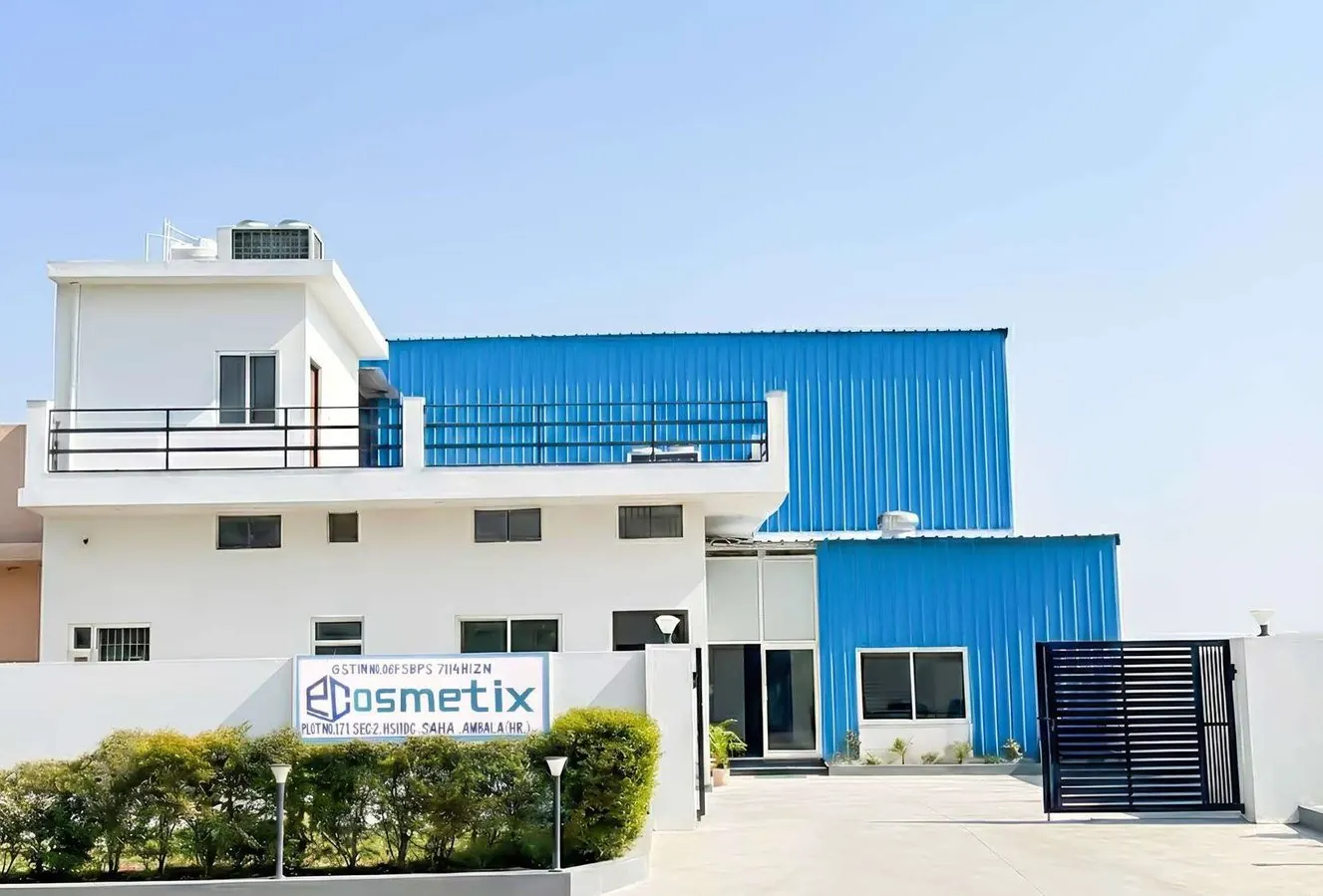
Ecosmetix is an R&D-led third-party manufacturer of skin care, hair care, body care and sun care products, with its plant in Ambala, Haryana and delivery across India. Brands come to us for third-party manufacturing of their own formula, private label launches from our 100+ graded formulas (Grade 1 to Grade 4), or fully custom products.
For founders, the licence step is easier when the product is already clear. Our R&D team usually turns a brief into lab samples in about 14 days, so your product list and composition are ready before you file. With mixing capacity of 16,000 kg per day and filling capacity of 60,000 tubes per day, the plant can scale once your first batch sells. Tell us in your brief which licence route you are planning, and our team will talk you through what is needed on the manufacturing side.
Ready to start? Share your product brief with your actives, target cost, pack size and benchmark, and our R&D team will reply within one working day.
Frequently asked questions
What is a cosmetic loan licence in India?
It is a licence under the Cosmetics Rules, 2020 for a person or company that wants to manufacture cosmetics for sale using the manufacturing site of another licensee. You apply in Form COS-6 to the State Licensing Authority, and the licence is granted in Form COS-9.
Can I sell cosmetics under my brand without my own licence?
Many brands launch with products made under their third-party manufacturer’s own licence, with the manufacturer’s name and licence number on the label and the brand shown as the marketer. Practice can differ by state, so confirm the position with your State Licensing Authority before you print packaging.
What is the fee for a cosmetic loan licence?
As listed by the Delhi Drugs Control Department from the Third Schedule of the Cosmetics Rules, 2020, the fee is ₹10,000 for up to ten items of each category and ₹500 for each additional item. Check your own state’s current fee table before filing.
How long does it take to get a cosmetic loan licence?
Rule 23(5) asks the State Licensing Authority to grant the licence, or tell you what is missing, within 45 days of the application. Preparing documents and products before filing usually takes longer than the decision itself.
What is the difference between COS-5 and COS-6?
Form COS-5 is the application for a cosmetic manufacturing licence for your own site; the licence is issued in COS-8. Form COS-6 is the application for a loan licence to use another licensee’s site; the licence is issued in COS-9. Both are filed with the COS-7 GMP self-certificate.
Is a cosmetic licence valid for life?
Under Rule 30, the licence is valid in perpetuity as long as the retention fee is paid before five years from the date of issue. Late payment attracts 2% per month for up to 180 days, after which the licence is deemed cancelled.
Which licence number goes on the label?
The label must show the manufacturing licence number with a prefix such as “M.L. No.” (Rule 34). If the product is made under the manufacturer’s licence, it is their number; if you hold a loan licence, it is your loan licence number.
References
- Cosmetics Rules, 2020 (CDSCO)
- Forms and fees for manufacturing licences of cosmetics, Drugs Control Department, Government of NCT of Delhi
- Legal Metrology acts and rules, Department of Consumer Affairs, Government of India
- Registration of PIBO/PWP as per EPR guidelines (FAQs), Maharashtra Pollution Control Board