
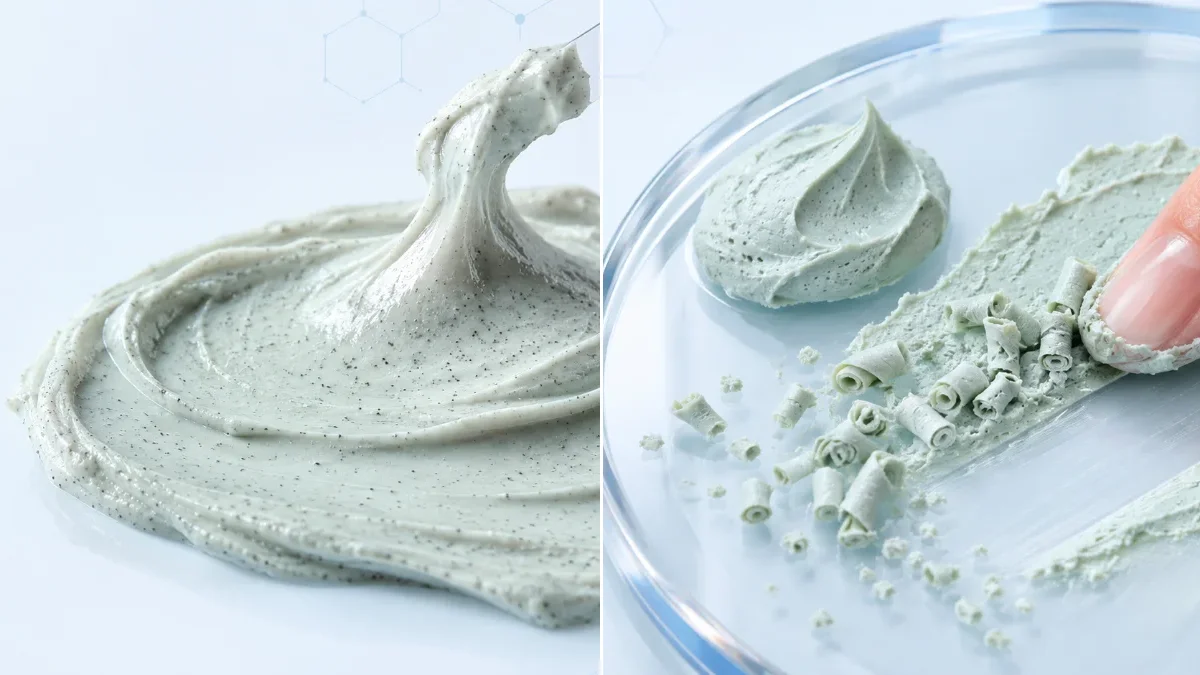
A clay scrub used to be a gritty paste in a tub. Today shoppers expect texture to be part of the experience: something they can see, feel and film. That is why more brands are asking a clay scrub manufacturer for a Clay Scrub Souffle, a whipped, airy clay that cleanses and polishes skin without the heavy, drying feel of an old-style mud pack. This guide explains the two souffle textures our R&D team builds most often, Fluid Clay and Gommage Clay (the rolling clay), and what each means for your formula, pack, claims and launch.
The guide is aimed at founders and product heads adding a clay or exfoliation SKU in India. Because our Ambala team formulates and fills these souffles every week, we share the practical choices behind them too, with references at the bottom of the page.
What is a Clay Scrub Souffle?
A souffle is a texture, not an ingredient. The product is aerated or whipped during manufacture so that it feels light and mousse-like when scooped, while still carrying a meaningful load of clay. Fine exfoliating particles or a rolling (gommage) system sit inside that airy base. The result is a product that spreads easily, rinses cleanly and looks premium in a jar or tube.
Inside a souffle, the clay does three jobs. It absorbs excess oil and helps lift surface grime, it gives the product body so it can hold particles in suspension, and it provides the colour and story a brand can build a range around. A review in the International Journal of Pharmaceutics notes that clay minerals are used in cosmetics as excipients to stabilise emulsions and suspensions and to change how a product flows, as well as for their absorbent properties.
The clays we work with most often in this format include kaolin (white or pink, gentle, suits sensitive and normal skin), bentonite and montmorillonite (stronger oil absorption, suits oily skin), French green clay, and red or rose clays for colour-led ranges. A 2024 review in Archives of Dermatological Research on bentonites and montmorillonites summarises early evidence on oil absorption and skin feel, while noting that larger clinical trials are still needed. We use that kind of evidence to shape the formula, and we keep consumer claims to what a test on the finished product can support.
Fluid Clay vs Gommage Clay: two souffle textures from one clay scrub manufacturer
Both textures start from the same idea: a whipped clay base. They differ in how the product behaves once it touches skin.
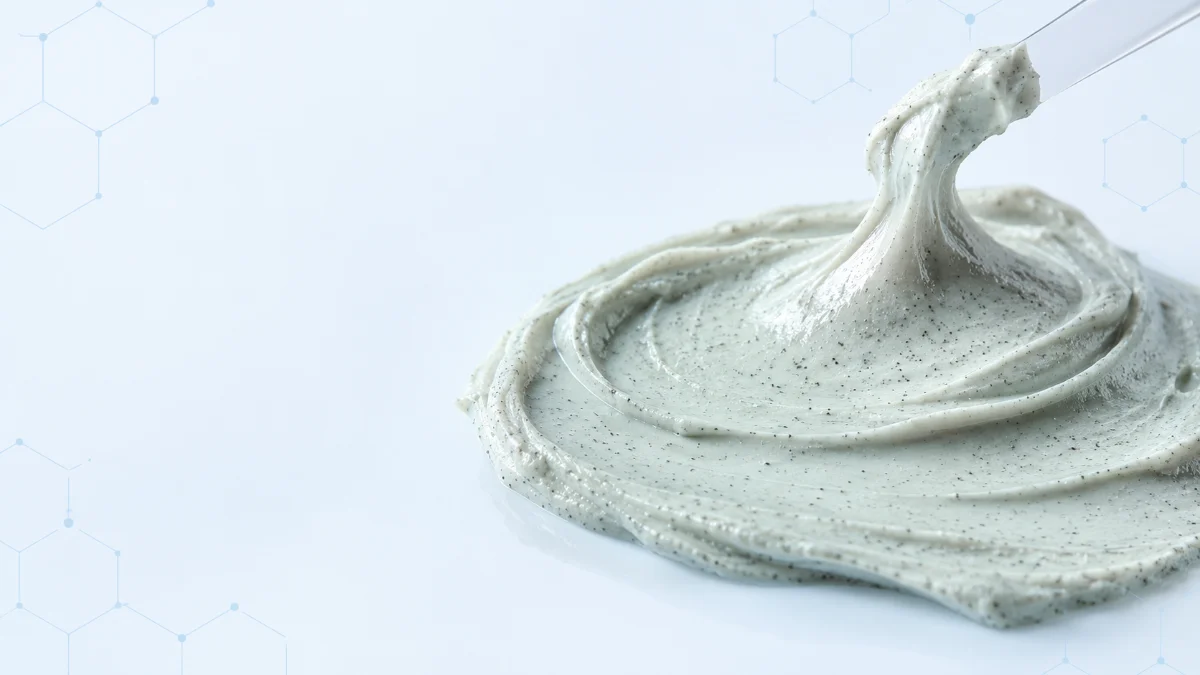
Fluid Clay souffle
Fluid Clay is the lighter, glide-on texture. It is whipped to a soft peak, spreads in one smooth stroke and carries fine, rounded exfoliating particles evenly through the base. On skin it feels creamy rather than gritty. The user massages it for a short time, rinses, and is left with clean, polished-feeling skin.
- Best for: daily or alternate-day cleansing scrubs, face and body ranges, and buyers who want a gentle polish.
- Exfoliation: physical, from fine particles. Their size, shape and amount set the intensity, so it can be graded from very gentle to firm.
- Pack: jar for the full souffle look, or a wide-orifice tube for hygiene and travel.
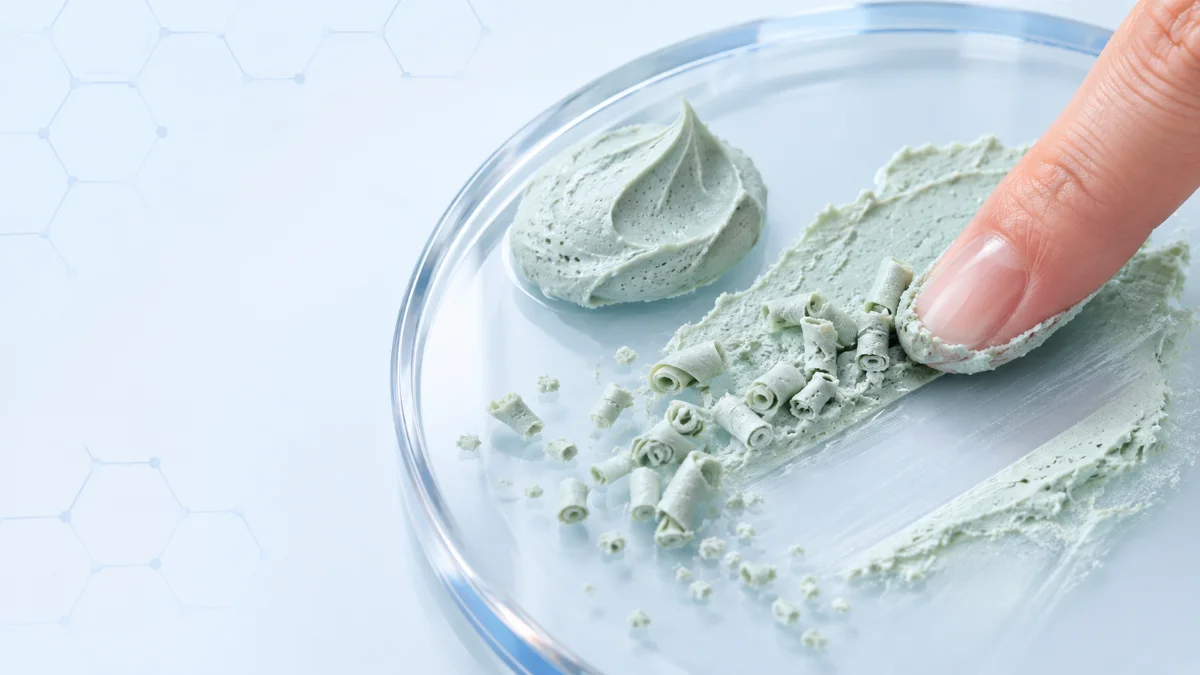
Gommage Clay souffle (rolling clay)
Gommage comes from the French word for an eraser, and the texture behaves like one. The souffle is spread in a thin layer and massaged. After a few seconds of rubbing it begins to gather into small, soft rolls that pick up surface grime and loose flakes, then rinse away. It is the texture that performs best in short videos, because the effect is visible.
The rolling effect is built into the formula. It typically comes from a controlled interaction between an anionic polymer and a cationic ingredient, which form a soft film that breaks into rolls under friction. Getting this right in a clay base takes careful balancing, because clay carries its own surface charge and can disturb the reaction. Too little of the cationic partner and nothing rolls; too much and the base thins, clumps in the jar or rolls before it has been spread.
- Best for: a weekly or twice-weekly rolling clay scrub, sensitive-skin buyers who dislike grit, and launches that rely on demo content.
- Exfoliation: mainly mechanical lifting by the rolls, with no hard particles, plus any mild chemical exfoliant you choose to add.
- Pack: tube or pump, so the base is protected from drying out between uses.
Side-by-side comparison
| Point | Fluid Clay souffle | Gommage Clay souffle |
|---|---|---|
| Feel on application | Creamy, whipped, glides in one stroke | Light film first, then soft rolls form while rubbing |
| How it exfoliates | Fine suspended particles | Rolling polymer film lifts surface grime and flakes |
| Grit | Yes, size chosen to the brief | None |
| Typical use | Daily to alternate days | Once or twice a week |
| Skin types it usually suits | Normal, oily, combination; body | Normal to sensitive; dull or flaky-looking skin |
| Key formulation risk | Particles settling or souffle collapsing | Rolling too early, too little or not at all |
| Best pack | Jar or wide-orifice tube | Tube or pump |
| Content angle | Swirl, swatch and "whipped" close-ups | Before-and-after of the rolling effect |
Many brands working with us as their clay scrub manufacturer in India launch both: a Fluid Clay souffle as the everyday cleanser-scrub and a Gommage Clay souffle as the weekly treat. Built on the same clay and fragrance, they read as one range and give the buyer a reason to purchase twice.
Be honest about what the rolls are
It is tempting to market gommage as "watch your dead skin roll away". We advise brands not to. Most of what gathers into rolls is the product itself, carrying surface oil, grime and some loosened flakes with it. Cosmetic chemist Michelle Wong of Lab Muffin Beauty Science reached the same conclusion when she examined peeling gels: the effect does lift flakes efficiently, but not as much skin as the size of the rolls suggests.
This matters for two reasons. Claims that the rolls are "all dead skin" can mislead shoppers and invite complaints. And customers who believe it may over-use the product on healthy skin. Better claims describe what the user can actually see and feel: skin that feels smoother, looks brighter after rinsing, and feels clean without tightness, each one supported by a consumer-use test on the finished formula. Our brand rule is simple: no claim without data.
Choosing exfoliants: what a responsible clay scrub manufacturer will not use
For Fluid Clay souffles, the exfoliating particle defines the product. India's Bureau of Indian Standards added plastic microbeads to its list of raw materials generally not recognised as safe for use in cosmetics. Amendment No. 2 to IS 4707 (Part 2) describes them as solid plastic particles of 5 mm or less used to exfoliate or cleanse in rinse-off products. So a modern scrub should not use plastic beads, and a manufacturer should be able to tell you exactly what the particle is made of.
Options we commonly evaluate include:
- Jojoba esters beads: smooth, wax-based spheres that melt or soften during massage; a gentle choice for face scrubs.
- Rice and oat powders: soft, fine and easy to explain on a label.
- Cellulose and bamboo powders: plant-based, available in several particle sizes for grading intensity.
- Volcanic or pumice powders: firmer; we keep these for body and foot products rather than the face.
We avoid sharp, irregular shells and pits for facial products. The American Academy of Dermatology advises choosing exfoliation to suit skin type, being gentle, and noting that people with sensitive skin may need a milder method. A rounded particle at the right size gives the polish buyers want without the scratchy feel.
This grading follows the same logic we use across our ranges, described in our guide to building a graded skin care range. It lets a brand offer a good-better-best line without developing four unrelated formulas.
Actives that pair well with a clay souffle
A souffle stays on skin for a short time, so actives should be chosen for what they can do in that window and for the story they add. Ingredients we often pair with clay include:
- Salicylic acid: for oily and acne-prone ranges, alongside bentonite or green clay.
- Lactic acid or fruit enzymes: a mild chemical boost that suits gommage souffles for dull-looking skin.
- Niacinamide: an easy-to-explain oil-balance and glow story.
- Charcoal: colour and a "deep cleanse" angle for men's and oily-skin lines.
- Glycerin, panthenol and plant oils: to stop the clay leaving skin tight after rinsing.
Each active has permitted levels and labelling conditions under the Cosmetics Rules, 2020. We confirm the regulatory position for every active and level before you approve a sample.
How we develop a Clay Scrub Souffle, step by step
- Brief. Tell us the texture (Fluid, Gommage or both), target skin type, face or body, pack, size and target cost. A benchmark product helps. Our guide on writing a cosmetic product brief lists what to include.
- Clay and exfoliant selection. We propose the clay blend, the exfoliating or rolling system and any actives, with the trade-offs explained.
- Lab samples. Samples are usually ready within 14 days. We often send two or three texture options side by side so you can compare feel and look.
- Stability. Souffles need extra checks: whether the whipped structure holds, whether particles settle, and for gommage, whether it still rolls correctly after storage in your final pack.
- Claims and label. We agree a claim list that matches the test data and the Cosmetics Rules, 2020.
- Production. Batches are made, filled, quality-checked and dispatched from our Ambala plant.
Questions to ask any clay scrub manufacturer
- Which clays do you hold in stock, and can you show the specification and microbial limits for each?
- What exactly is the exfoliating particle, and can you confirm it is not a plastic microbead?
- How do you keep the souffle aerated through shelf life, and what stability data will I receive?
- For gommage, how is the rolling effect controlled, and will it still work after months in my pack?
- Can you supply both textures on one clay base so my range looks and smells consistent?
- Which claims can this formula support, and what testing is needed for each?
Why brands choose Ecosmetix as their clay scrub manufacturer
Texture is one of our specialities: our R&D team works across 15 to 20 texture types, from souffles and gel-creams to gommage and encapsulated formats. Lab samples are usually ready within 14 days, and our plant has a mixing capacity of 16,000 kg per day with tube filling of up to 60,000 units per day, so a launch can scale without changing manufacturer. Clay souffles sit within our wider skin care manufacturing and private label services (a private label clay scrub can start from one of our tested souffle bases), so a scrub can be built to match the cleanser, serum or mask in the same range.
Want to see and feel Fluid Clay and Gommage Clay side by side? Fill in our product brief form with the texture you like, the skin type you are targeting, your pack and your price point. Our R&D team will suggest a clay blend and send souffle samples with costing.
Frequently asked questions
What is a Clay Scrub Souffle?
It is a clay cleanser-scrub whipped into a light, mousse-like texture. It carries clay for oil absorption plus either fine exfoliating particles (Fluid Clay) or a rolling gommage system (Gommage Clay), and rinses off after a short massage.
What is the difference between Fluid Clay and Gommage Clay?
Fluid Clay glides on in one smooth stroke and polishes with fine suspended particles. Gommage Clay has no grit; when a thin layer is rubbed it gathers into soft rolls that lift surface grime and flakes before being rinsed away.
Are the gommage rolls dead skin?
Mostly not. The rolls are largely the product itself, carrying surface oil, grime and some loosened flakes. We advise brands to describe what users can see and feel, such as smoother-feeling skin, and to back each claim with testing.
Can a clay scrub use microbeads?
Plastic microbeads used to exfoliate or cleanse in rinse-off products are on the BIS list of raw materials generally not recognised as safe for cosmetics. We use options such as jojoba esters beads, rice, oat, cellulose or bamboo powders instead.
How often should a clay scrub souffle be used?
Fluid Clay souffles with soft particles are usually designed for daily or alternate-day use, while Gommage Clay souffles suit once or twice a week. Final directions depend on the formula, its exfoliation level and the target skin type.
Which pack is best for a clay souffle?
A jar shows off the whipped look of a Fluid Clay souffle, while a tube or pump protects a Gommage Clay souffle from drying out between uses. We confirm stability in your chosen pack before production.
How long does it take to develop a clay scrub souffle?
Our team usually sends first souffle samples within 14 days of receiving a clear brief. The full timeline then depends on how many texture rounds you want, how the souffle holds up in your chosen pack during stability, and when your claims and artwork are signed off.
Can I launch both textures under my brand?
Yes. Many brands launch a Fluid Clay souffle for everyday use and a Gommage Clay souffle as a weekly treatment, built on the same clay and fragrance so they read as one range.
References
- Moraes JDD, et al. Clay minerals: properties and applications to dermocosmetic products and perspectives of natural raw materials for therapeutic purposes. Int J Pharm 2017
- Zafar K, et al. The potential cutaneous benefits of bentonites and montmorillonites. Arch Dermatol Res 2024
- Bureau of Indian Standards: Amendment No. 2 to IS 4707 (Part 2):2017, plastic microbeads
- Wong M. Do peeling gels really peel off my skin? Lab Muffin Beauty Science
- American Academy of Dermatology: How to safely exfoliate at home
- CDSCO: Cosmetics Rules, 2020 (PDF)